Dear Esteemed Colleagues,
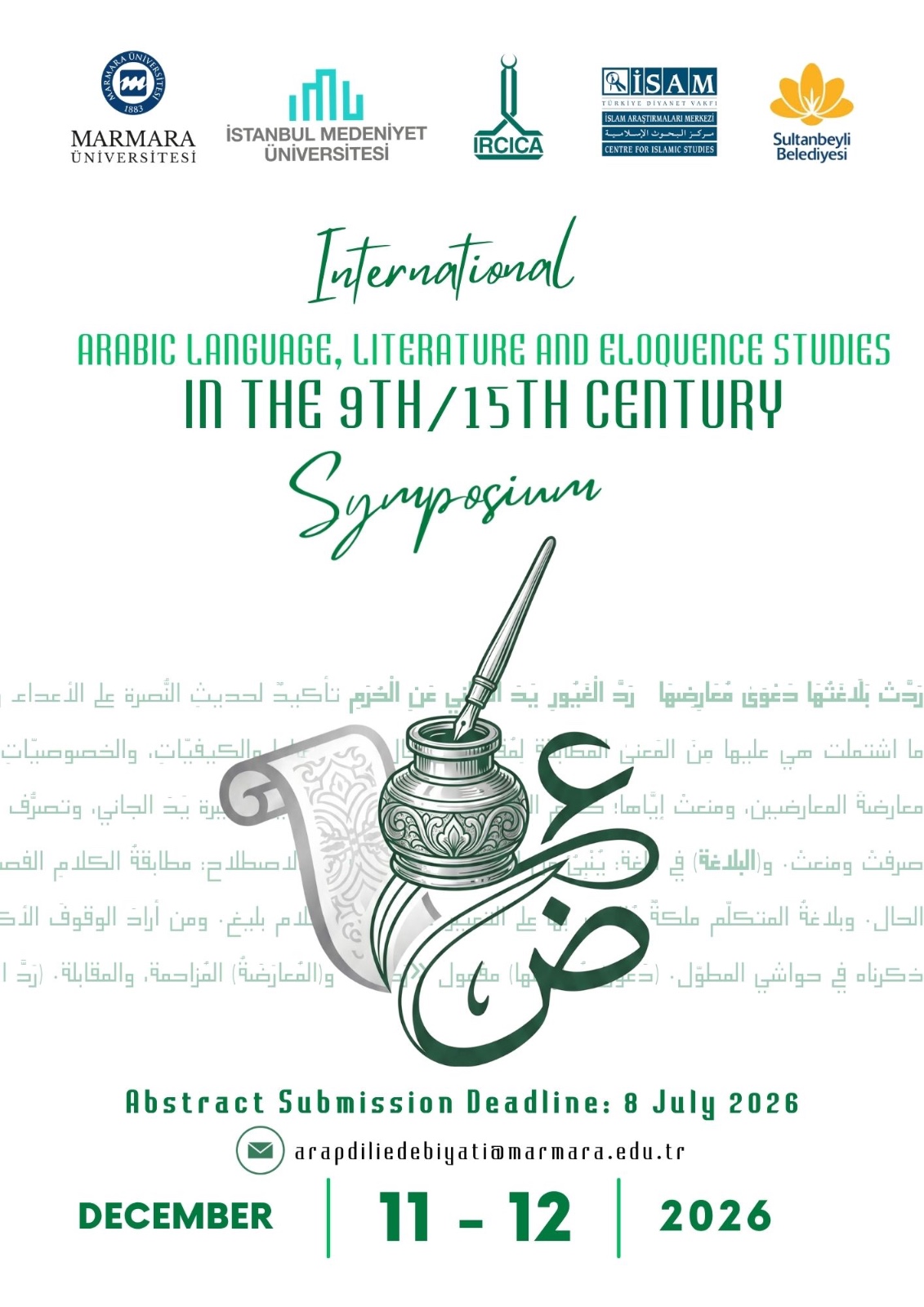
In December 2026, a symposium entitled “Studies in the Arabic Language, Literature, and Rhetoric in the 9th/15th Century” will be organized through the collaboration of the Departments of Arabic Language and Rhetoric at the Faculty of Theology of Marmara University and the Faculty of Islamic Sciences at Istanbul Medeniyet University, in addition to the Research Centre for Islamic History, Art and Culture (IRCICA) and the Center for Islamic Studies (İSAM). The symposium aims to examine the authors who produced works in the aforementioned century and their writings, as well as to analyze the theories and perspectives of the period through scholarly discussion and analytical study. In this context, particular emphasis is expected to be placed on Anatolia, as well as on the Mamluks centered in the Levant and Egypt who exerted influence on Anatolia, in addition to the Turkestan–Iran region. The figures, texts, and views that will form the basis of the presentations are of particular significance in demonstrating the impact of the Ottoman Empire and its contributions to Arabic literature. Indeed, this symposium constitutes the second in a series of symposia aimed at highlighting the Arabic language, literature, and rhetoric in the Ottoman period. The first, which addressed the 14th century, was held in 2024 and resulted in numerous studies that shed light on that period.
In the 9th/15th century of Islamic civilization, the scholars and litterateurs of the period produced a substantial number of significant works in the field of ʿilm al-adab, through which they recorded the prevailing scholarly, literary, and intellectual traditions of their time. Undoubtedly, the influence of these scholars and their works continued into subsequent centuries. Understanding the traditions of Islamic scholarship and literature that flourished in Anatolia, as well as identifying the principal references relied upon by Ottoman scholars and litterateurs, can only be achieved by tracing this influence. The journeys undertaken for various reasons to major centers of learning and literature—such as Khurasan, Samarkand, Herat, Damascus, Tabriz, and Cairo—along with the scholarly exchanges that accompanied them, constituted key elements that nourished the Islamic civilization centered in Anatolia in subsequent centuries. The principal works produced in this period in the field of ʿilm al-adab—including lexicography; al-ṣarf (morphology), al-naḥw (syntax), al-balāgha (rhetoric), al-adab (literature), and al-waḍʿ—represented a continuation of the preceding period and, at the same time, served as fundamental references for the subsequent period.
In recent years, although academics have directed their attention to the 15th century from the perspectives of scholars, works, and ideas, a significant portion of these studies has been undertaken without due consideration of the comprehensive systematic structure of ʿilm al-adab, its problematics, and its chronological development. Consequently, the fragmentary studies conducted thus far have remained insufficient to provide a comprehensive picture of the period or to reach well-founded conclusions. For this reason, the 15th-century Ottoman context will be addressed in this symposium from a broader perspective. The symposium will focus, within the context of the 9th/15th century, primarily on scholars who were born, raised, and received their foundational education in Anatolia; as well as those who passed through it; those who lived in the same century and exerted influence there through teaching or study; and those who, although they did not personally come, exerted influence through their works. It will also examine the works of these scholars and the issues that were the subject of scholarly discussion and debate during the period, with the aim of presenting the Ottoman-centered intellectual accumulation of the time.
Finally, religious literature; the Munshaʾāt tradition, in which artistic prose centered on chancery writing and diplomacy emerged; scholars such as Molla Lütfi, Musannifek, Yusuf al-Kirmastī, and Bedreddin al-Aynī, who were either raised in Anatolia or influential in Anatolia, together with their works; as well as the major debates and prominent issues of the period, will constitute the main focus of this symposium.
Symposium Languages: Turkish, English, and Arabic
Abstract Word Limit: 250 words
Deadline for Abstract Submission: 8 July 2026
Announcement of Accepted Abstracts: 22 July 2026
Deadline for Full Paper Submission: 4 November 2026
Symposium Dates: 11–12 December 2026
Meeting Dates: 11–12 December 2026
Venue:
Faculty of Theology, Marmara University / Faculty of Islamic Sciences, Istanbul Medeniyet University
Contact E-mail: arapdiliedebiyati@marmara.edu.tr
Website: arapdiliedebiyati.etkinlik.marmara.edu.tr
Address:
İslam Araştırmaları Merkezi (İSAM), İcadiye Bağlarbaşı Avenue, No: 38, 34662 Üsküdar/İstanbul
Note: Selected papers presented at the symposium will be published as chapters in an edited volume. During the symposium, participants' accommodation and meal expenses will be covered by the organizing committee.
Bu sayfa Arap Dili ve Belagatı Anabilim Dalı Etkinlikleri tarafından en son 24.06.2026 11:50:17 tarihinde güncellenmiştir.


